- Introduction
-
Many attempts have been made to decipher the Voynich Manuscript. Here, I would like to approach the question of what its writing and illustrations represent from a somewhat different perspective.
The diagrams in this manuscript do not seem merely to depict things. They also appear to construct some kind of “relationships” or “system” within the diagrams themselves.
If this is the case, what kind of system might it be?
As one possibility, I have considered the manuscript from the perspective of music.
 Scroll down to the bottom of this page to read the
“Further Observations”
which is updated regularly.
- 1. The Possibility of Reading the Voynich Manuscript as Diagrams for Understanding a System
When examining the imagery of the Voynich Manuscript, the first thing to notice is not necessarily what the individual plants or figures mean, but rather the remarkably strong structural quality of the diagrams themselves.
In particular, some of the plant illustrations have features that seem unnatural if we regard them as straightforward observations of plants found in nature. Roots, stems, leaves, and flowers appear to be arranged not simply to reproduce the external appearance of a plant, but according to some kind of underlying order.
In other words, rather than recording plants as they exist in nature, the illustrations may be using the form of a plant to construct some kind of structure artificially.
Something similar can be observed in the illustrations of figures and water. The arrangement of numerous women placed successively along flowing water seems unusual if viewed as ordinary figurative art or a natural landscape. Instead, the composition appears to have been constructed with a certain order or set of relationships in mind.
The circular diagrams, too, can be viewed not so much as representations copied from naturally existing objects, but as geometrically constructed diagrams in which relationships such as center and circumference, division, repetition, and circulation have been deliberately arranged.
Viewed in this way, the plants, the figures and water, and the circular diagrams appear at first to be entirely different kinds of images. Yet they seem to share one common characteristic:
Rather than simply depicting something as it is, they appear to construct some kind of relationship or system within the diagram itself.
We may not be able to identify immediately what they depict. Nevertheless, it is possible to approach them from the perspective that they represent some kind of structural system.
What, then, might this system be?
- 2. Can Existing Interpretations Explain the Manuscript as a Whole?
There are several possibilities to consider.
Cosmology or astrology could explain circular diagrams, cycles, and arrangements relatively well. However, it seems difficult to explain both the artificial structures of the plants and the successive arrangement of figures along flowing water through a single underlying principle.
Natural science or natural history could readily account for the plant illustrations. Yet the plants appear to have structures unlike those normally found in botanical illustrations, and difficulties remain in incorporating the figures, water, and circular diagrams into the same system.
Medicine or pharmacy could provide meaning for the combination of plants, water, and the human body. However, further assumptions would still be needed to explain the circular diagrams and repetitive arrangements as parts of a single structure.
A calendar or system of time might explain circles, cycles, flowing water, and the successive arrangement of figures. On the other hand, further investigation would be needed to explain the structural depiction of plants according to the same principle.
Alchemy or natural philosophy might account for an even wider range of elements. Yet precisely because these fields are so broad, they can potentially be used to explain almost anything, making it difficult to derive a specific system from the structures of the diagrams themselves.
Of course, none of these possibilities can simply be ruled out.
But another possibility now emerges.
What if these diagrams were devices for thinking about a system called “music”?
- 3. Reading the Plants, Figures and Water, and Circular Diagrams from a Musical Perspective
In music, particularly counterpoint, multiple voices each maintain their own independent movement while interacting with one another over time to form a single composition.
Viewed from this perspective, the three types of diagrams may represent different aspects of such a process.
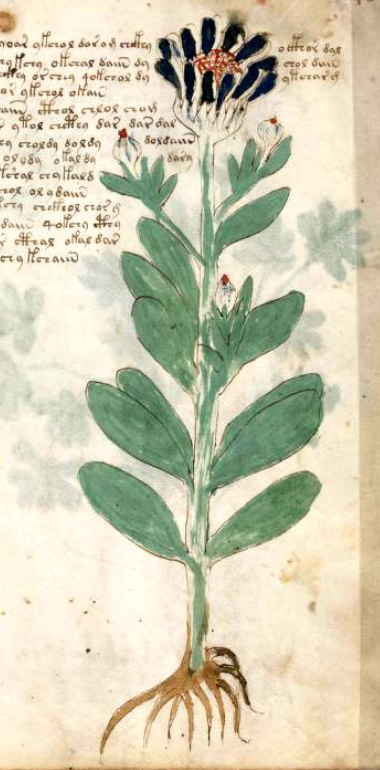
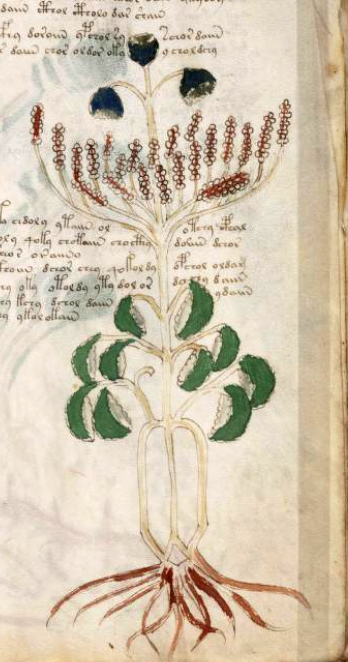
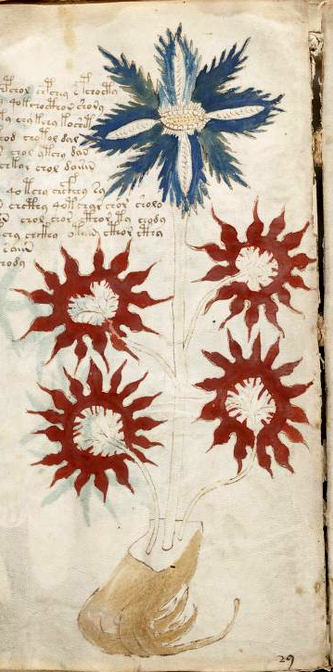 Plant Illustrations — Vertical Relationships
The roots, stems, leaves, and flowers of a plant form a hierarchical structure. Rather than existing independently, these elements relate to one another to form a unified whole.
Translated into musical terms, this may evoke the relationships among the elements that constitute a musical figure, as well as the process by which a musical figure changes and develops while taking shape as a motif.
Figures and Water — Horizontal Flow and Time
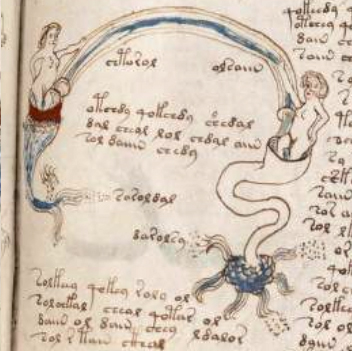
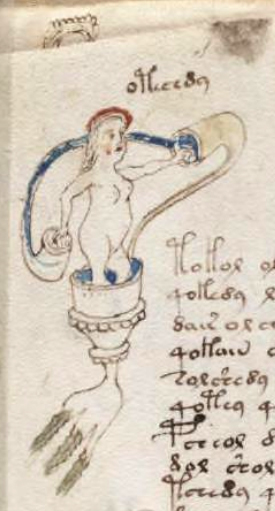
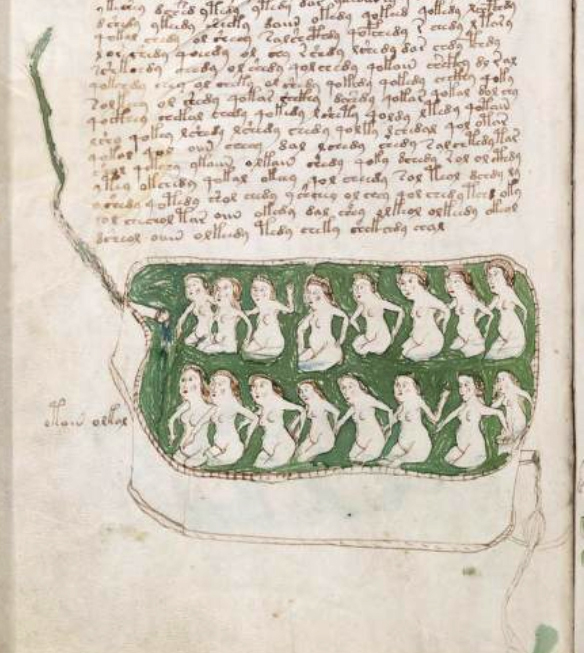
In the illustrations of figures and water, numerous women are arranged successively along the flow of water.
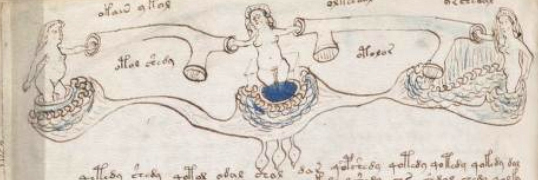
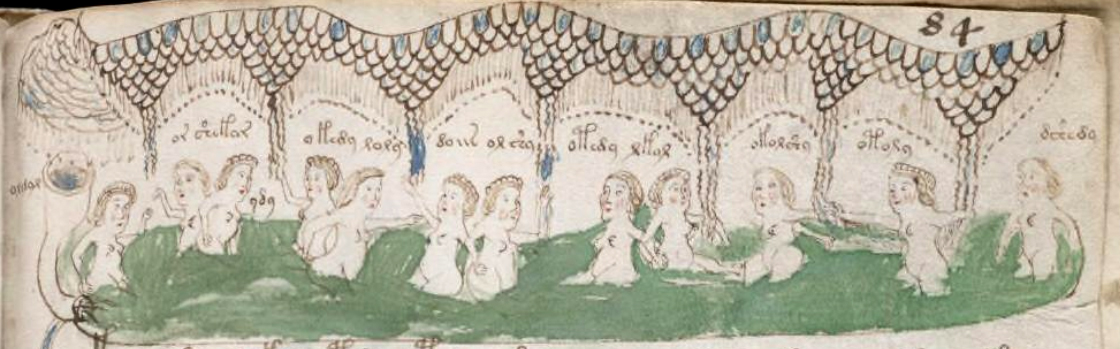
Some of these arrangements appear to have no clearly defined beginning or end, while others seem to form relatively short, self-contained units. There are also structures in which a woman's body appears to connect in several different directions.
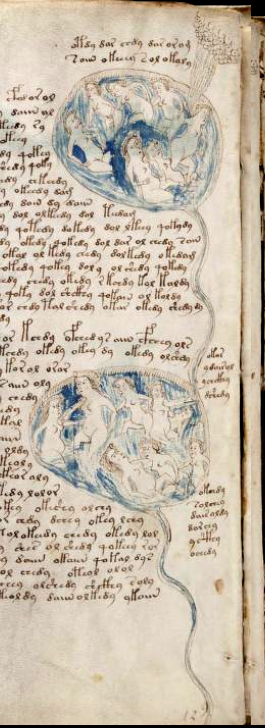
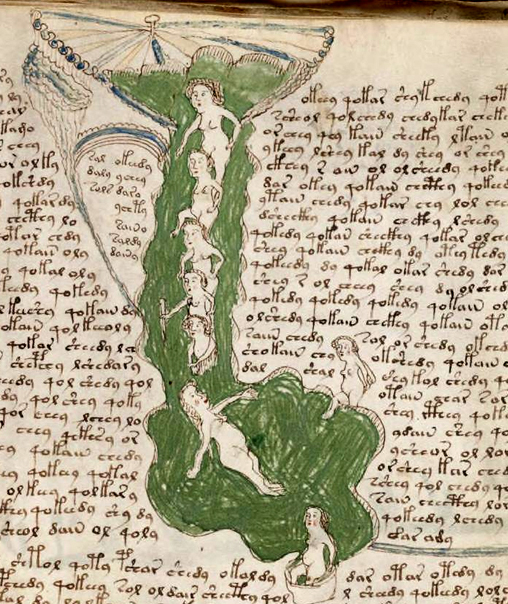
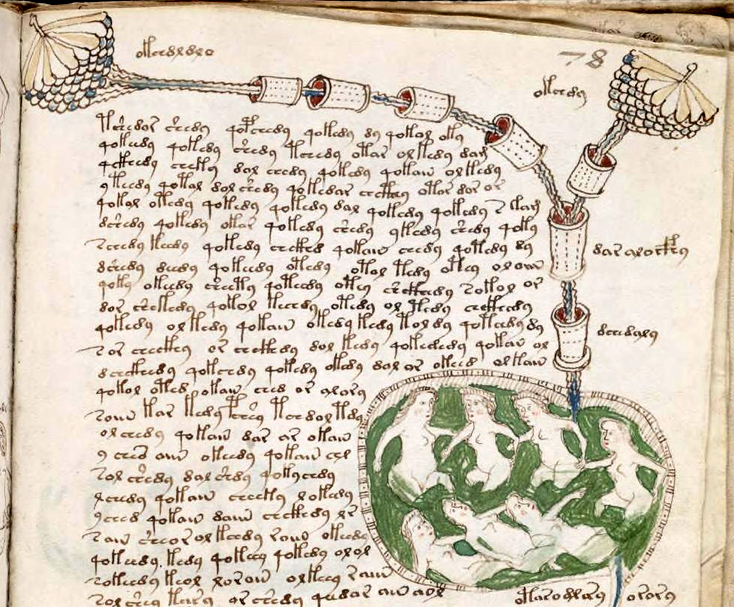
Translated into musical terms, these images may evoke melodies, phrases, melismas, and the imitation and linking of voices, measures, and other musical elements—in other words, structures in which musical figures change over time to form phrases and cadences of varying lengths.
In modern musical notation, the passage of time unfolds horizontally along the staff. These diagrams, too, can be viewed as structures in which elements connect horizontally to create a flow.
Furthermore, because the elements appear to be linked through the flow of water, we might also imagine longer melodic relationships in which one musical figure is handed over to the next.
Circular Diagrams — The “Tailor”
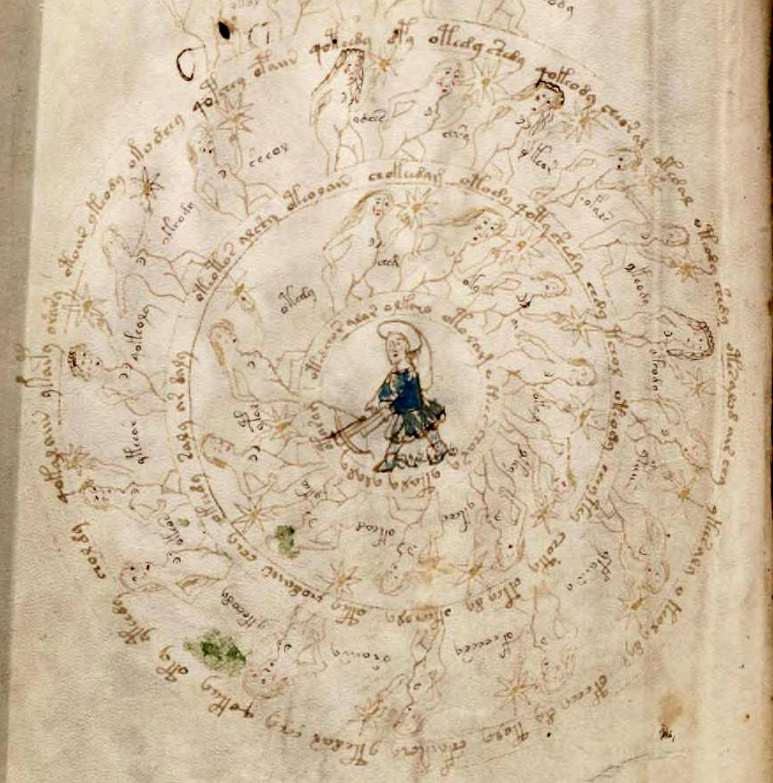 The circular diagrams take various forms, some resembling one another and others appearing as independent designs. They also seem to fall into several groups, although the overall variety of types does not appear especially large.
There is one particular image depicting a figure aiming a bow and arrow in the center, surrounded by numerous women.
This figure seems to symbolize an act of selection. If the circular diagrams represent stages in which motifs are shaped into phrases through various procedures, including the selection of motifs, the other circles may likewise be associated with different stages of the process.
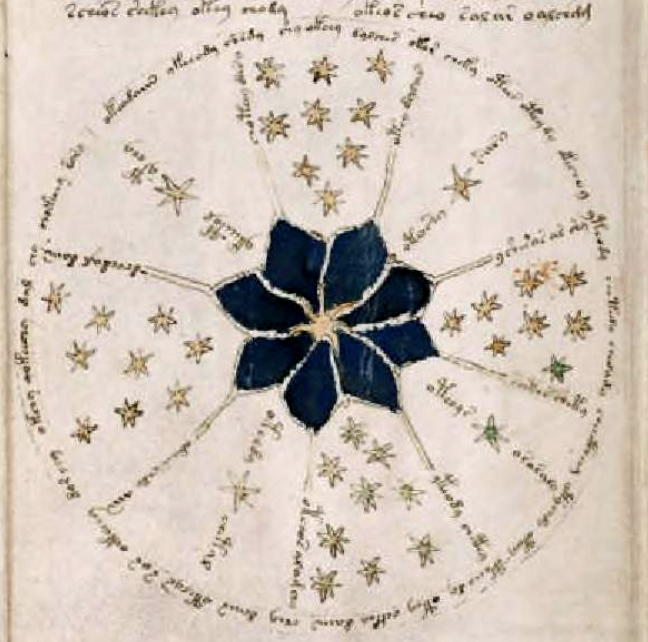
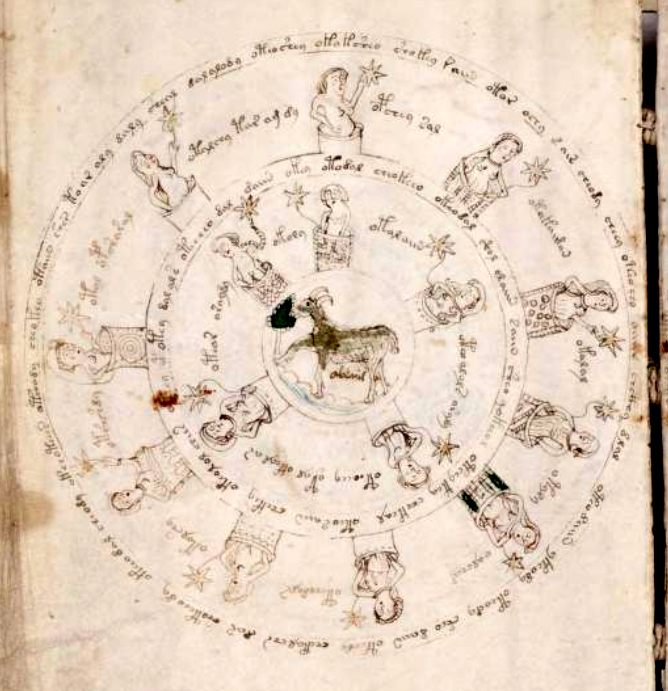
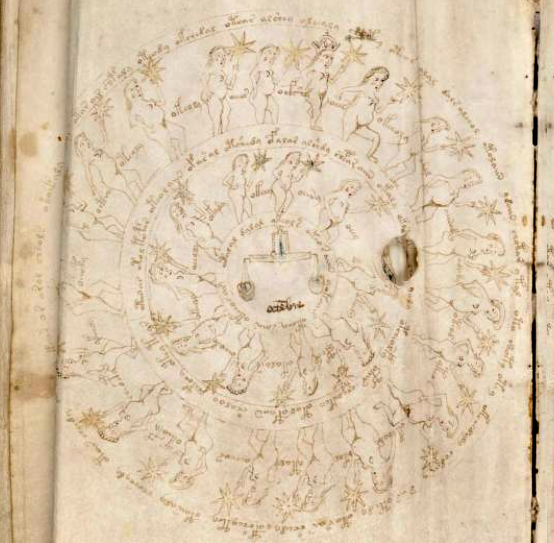
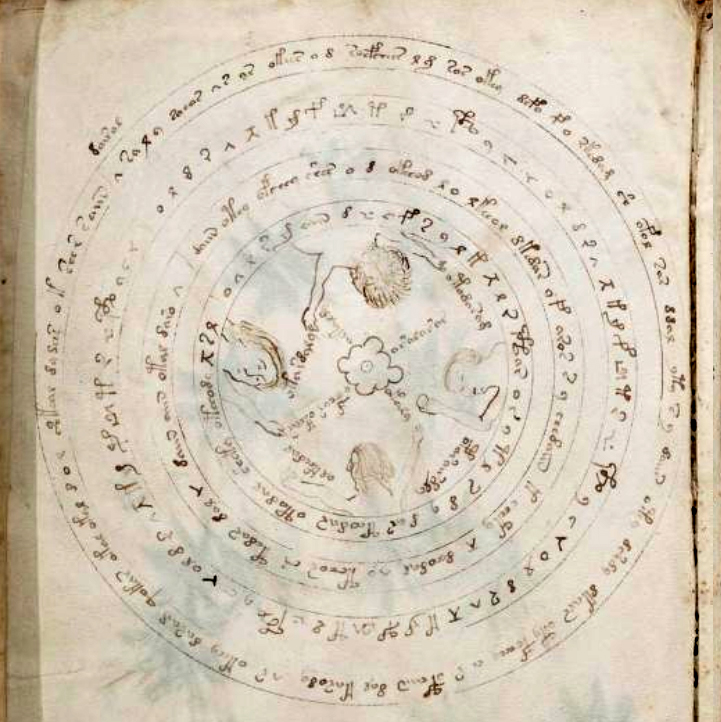 For example, one diagram shows numerous women surrounding a central animal and appearing to act upon it, as though they were working to develop a motif into something larger. Other diagrams might be interpreted as depicting operations such as dividing a motif into several parts, rotating it, or balancing its elements—in short, different ways of tailoring a motif.
The circular diagrams may therefore represent specialized operations through which motifs and phrases are modified and shaped in various ways. We might also imagine that the motifs and phrases fashioned through these operations are then reflected in the flow depicted in the illustrations of women and water.
- 4. The Relationship Between the Three Types of Diagrams
The observations so far can be summarized as follows:
- Plants = Vertical: Relationships among the elements that constitute a musical figure
- Women and water = Horizontal: The flow of musical figures and phrases through time
- Circles = Tailoring: Techniques for modifying and combining motifs
From these different perspectives, the three types of diagrams may represent musical operations that evoke the principles of counterpoint.
- 5. Writing and Oral Instruction
Another question worth considering is the role of the writing found in the manuscript.
It is possible that, during this period, knowledge and techniques were transmitted through oral instruction accompanied by practical training.
If so, the writing in this manuscript may not consist solely of characters intended to be read as sentences. It may also include symbols used together with the diagrams to communicate techniques and procedures.
Here, I would like to draw attention to one particularly large foldout spread in the manuscript.
- 6. A Large Foldout Diagram Representing a System for Creating Music
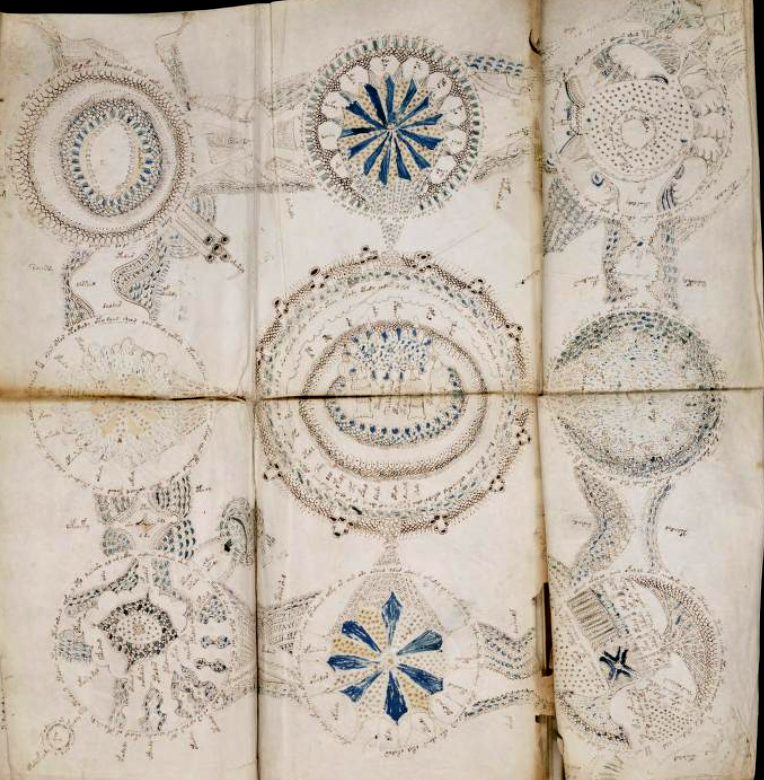 This spread contains a central circle surrounded by eight other circles. Some of the surrounding circles are connected to the center, and the overall arrangement resembles structures found in explanatory diagrams from the alchemical tradition of the period.
However, these circles may differ somewhat from the individual circular diagrams discussed earlier. The eight surrounding circles may not represent isolated operations. Rather, they may represent a mechanism for coordinating several operations—for example, enlarging a motif and aligning its ends, or transforming a motif and shifting its position. In other words, the diagram may depict a system that coordinates the work of multiple “tailors.”
Using the structure of this large foldout as a starting point, we can therefore consider the possibility that a system of musical techniques was explained through diagrams and oral instruction.
Viewed in this way, the Voynich Manuscript may have been a kind of technical manual through which people possessing the necessary knowledge could understand a system for creating music by means of diagrams and oral instruction.
Interestingly, this possibility also has something in common with the study of counterpoint today.
Even when learning counterpoint today, simply reading a theoretical textbook is not enough. Practical study is also important: students write music themselves and then receive oral corrections and guidance from a master.
The above is one interpretation of the Voynich Manuscript, derived from its illustrations: that the manuscript models the mechanisms of musical composition and presents the techniques involved in a systematic way.
- 7. Conclusion
Determining whether this hypothesis is historically accurate would require physical examination of the manuscript itself, as well as documentary and historical evidence.
Now that AI-based analytical methods are advancing, various approaches may be possible for examining the structures of the diagrams, their repetitions and arrangements, and their correspondence with the writing.
Toru Maruyama
Note on Counterpoint
Here, counterpoint refers to more than simply combining multiple independent melodies. It also encompasses the transformation and development of musical figures through imitation and their relationships with one another, in order to create a unified piece of music. It is an important system of musical techniques that has a long history and remains relevant today.
Further Observations
Were the Plants Grafted Artificial Flowers?!
Plants are basically made up of several parts: roots, stems, leaves, and flowers.
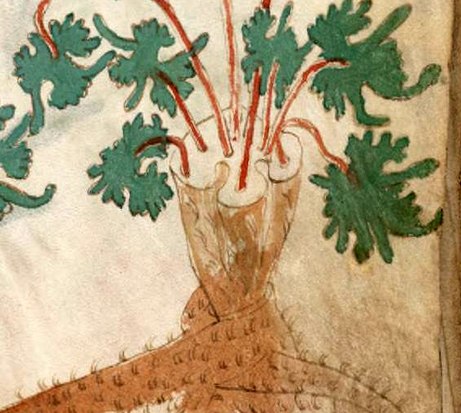
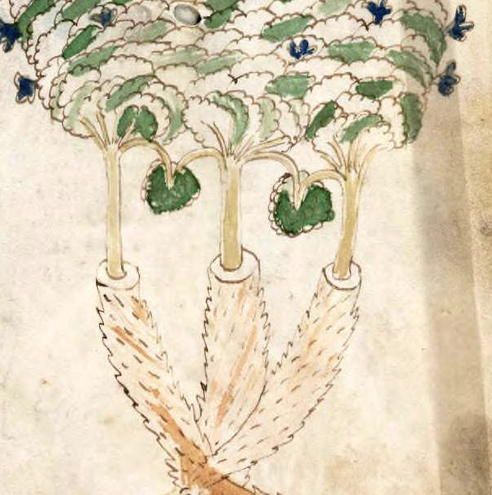
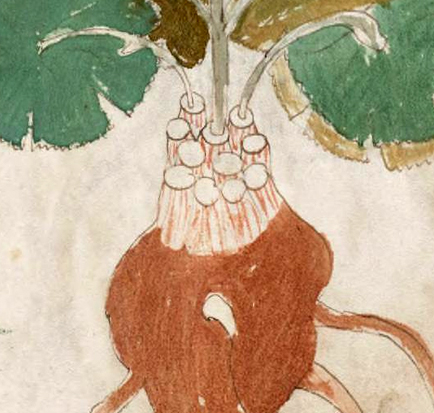
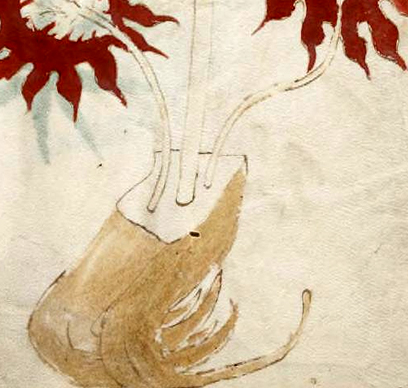
However, one feature of the plant illustrations in the Voynich Manuscript is particularly intriguing: the point where the root and stem meet. In many drawings, it looks as though the stem has been attached to the cut end of the root afterward.
Rather than depicting natural plants as they are, these illustrations look as though they show plants assembled from several parts, almost like “artificial flowers made by grafting.”
Interestingly, in the latter part of the manuscript, there are pages where groups of plants with distinctive roots are listed separately from groups with distinctive stems and leaves.
Lists of Plants with Strong Roots and Plants with Strong Stems and Leaves
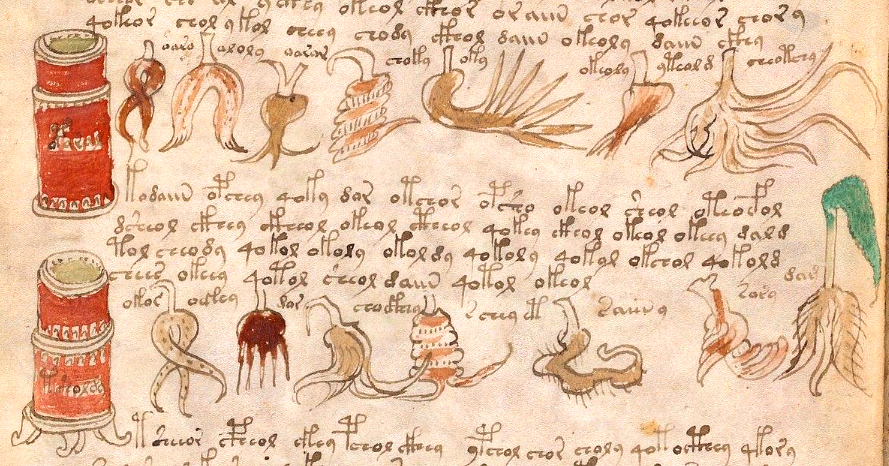
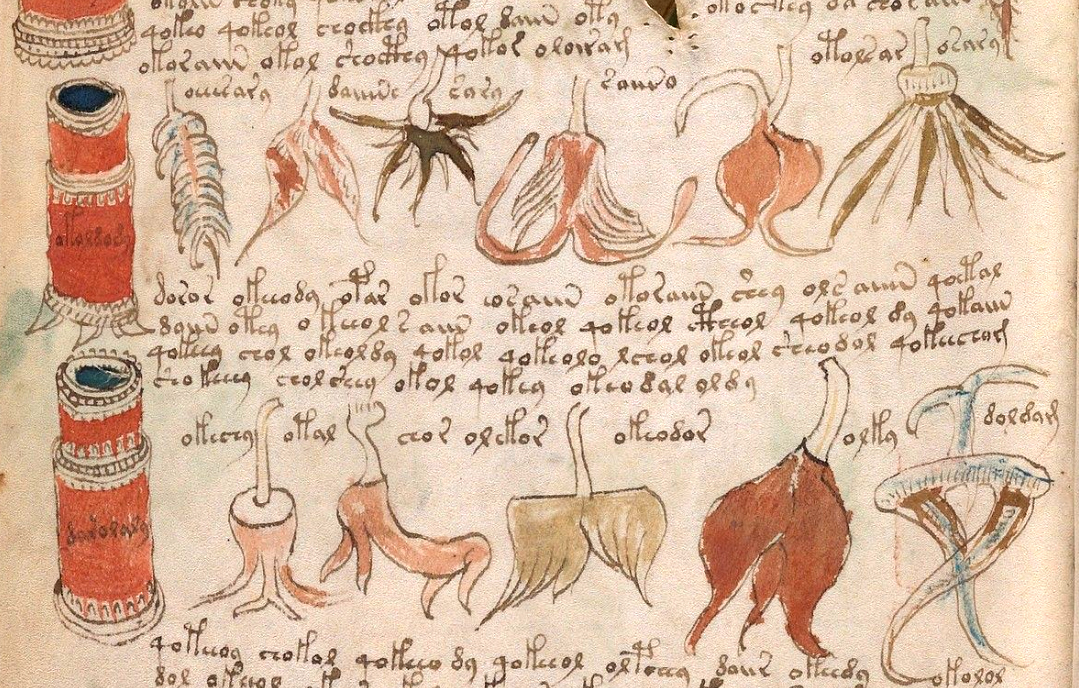
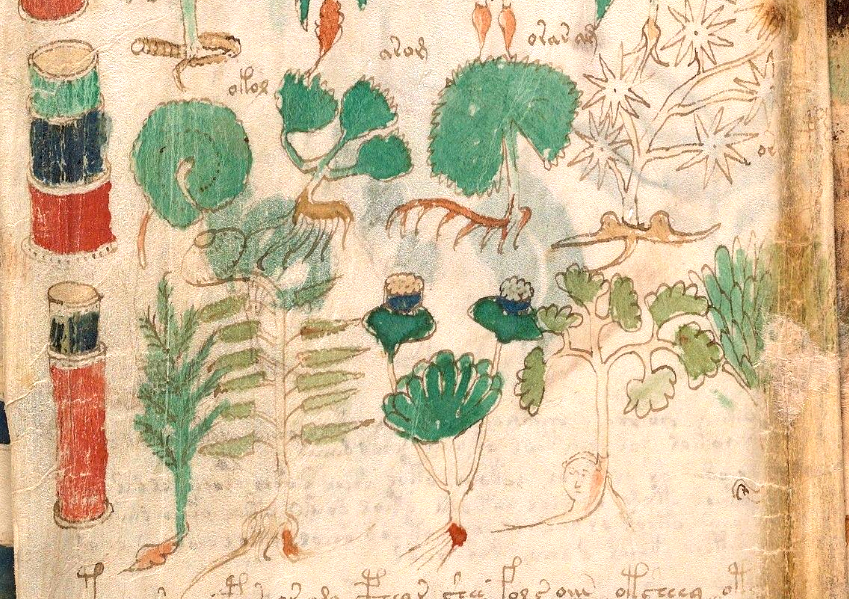
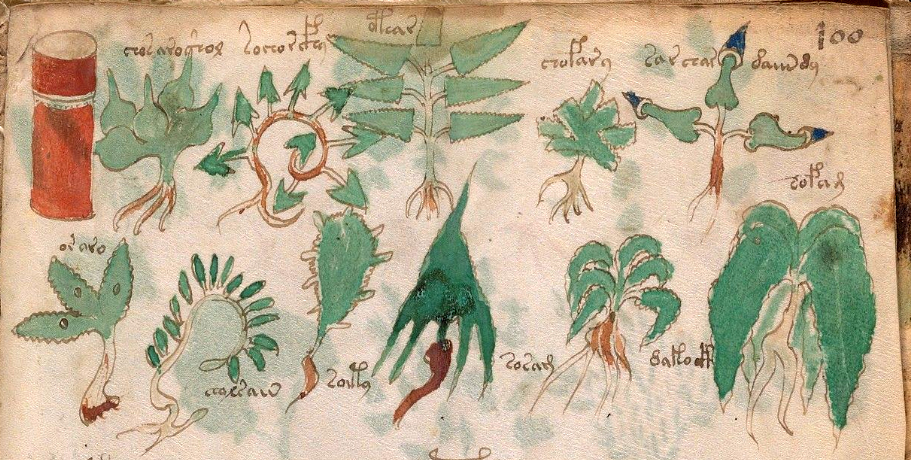 At the beginning of each horizontal row of illustrations, there is something that looks like a tube.
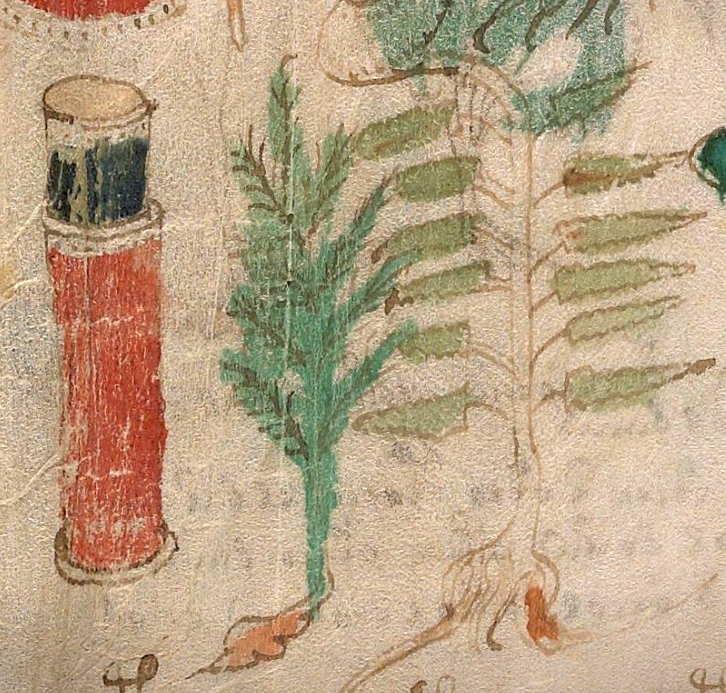
Previous hypotheses may have treated these objects as vessels used to boil and combine plants. But if we assume that the roots and stems are connected to one another, wouldn't it make sense to interpret these tubes as attachments designed to join them?
Supporting this idea, the groups of plants with particularly long stems also have correspondingly long tubular attachments.
The Structure of the Attachments
Comparing the various attachments reveals a common structural feature. Each attachment consists of two, or at most a few, tubular sections. There is one exception in which the sections are the same width at both ends, but generally, the bottom section is wider and the section above it is narrower.
Now, even if attachments are needed to connect roots and stems, if each has its own separate attachment, how are the two attachments supposed to fit together? Surely, one attachment should be enough.
The answer lies in their shape.
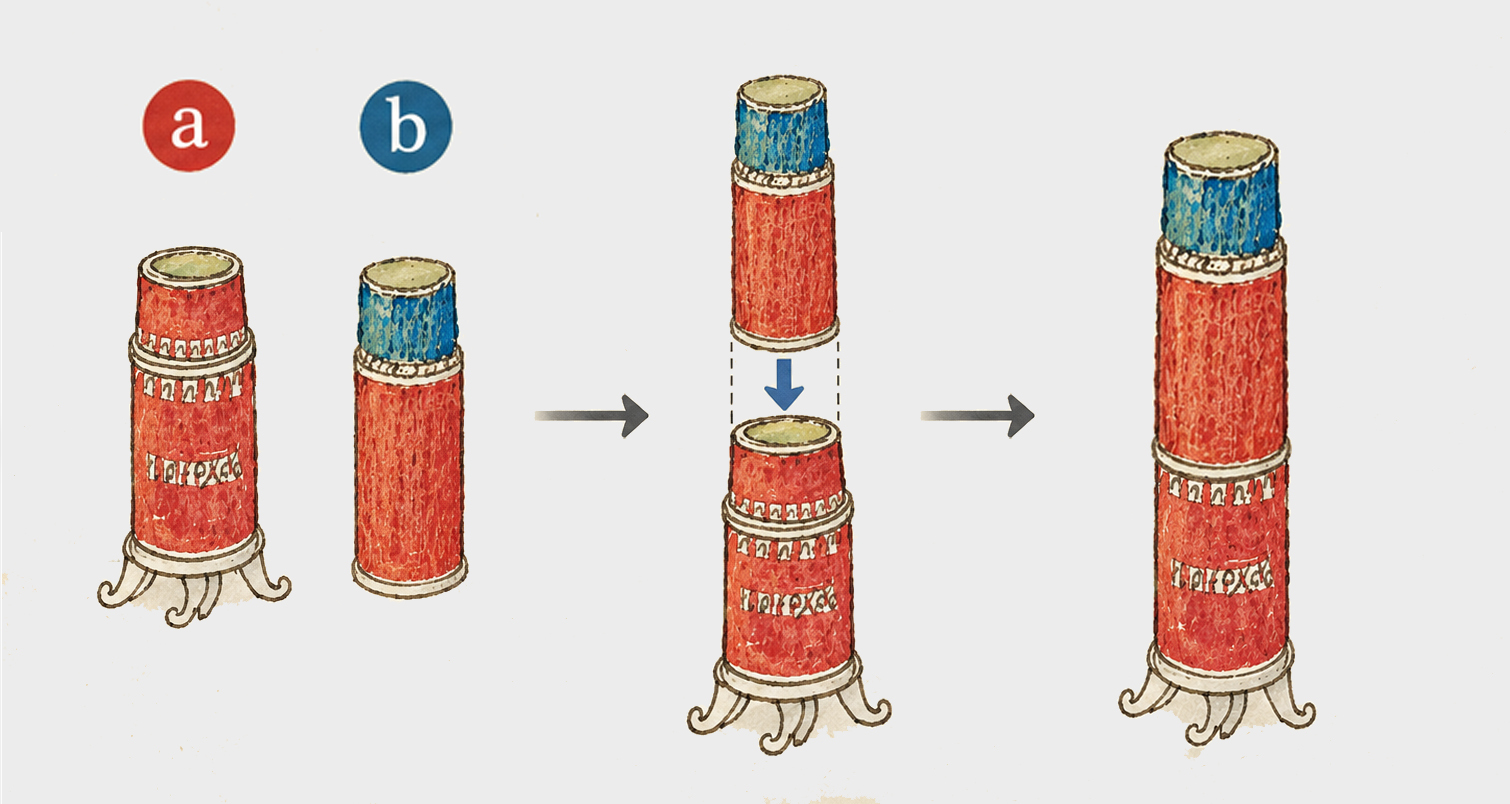 The narrow upper part of the root attachment(a) can be inserted into the wider lower part of the stem attachment(b), joining the two into a single assembly. Conversely, the wider lower part of the stem attachment(b) can fit over the narrow upper part of the root attachment(a), enclosing it from above.
Hanasaki System(Flowering System)
Among the circular diagrams in the manuscript is an illustration that clearly shows how these attachments are used.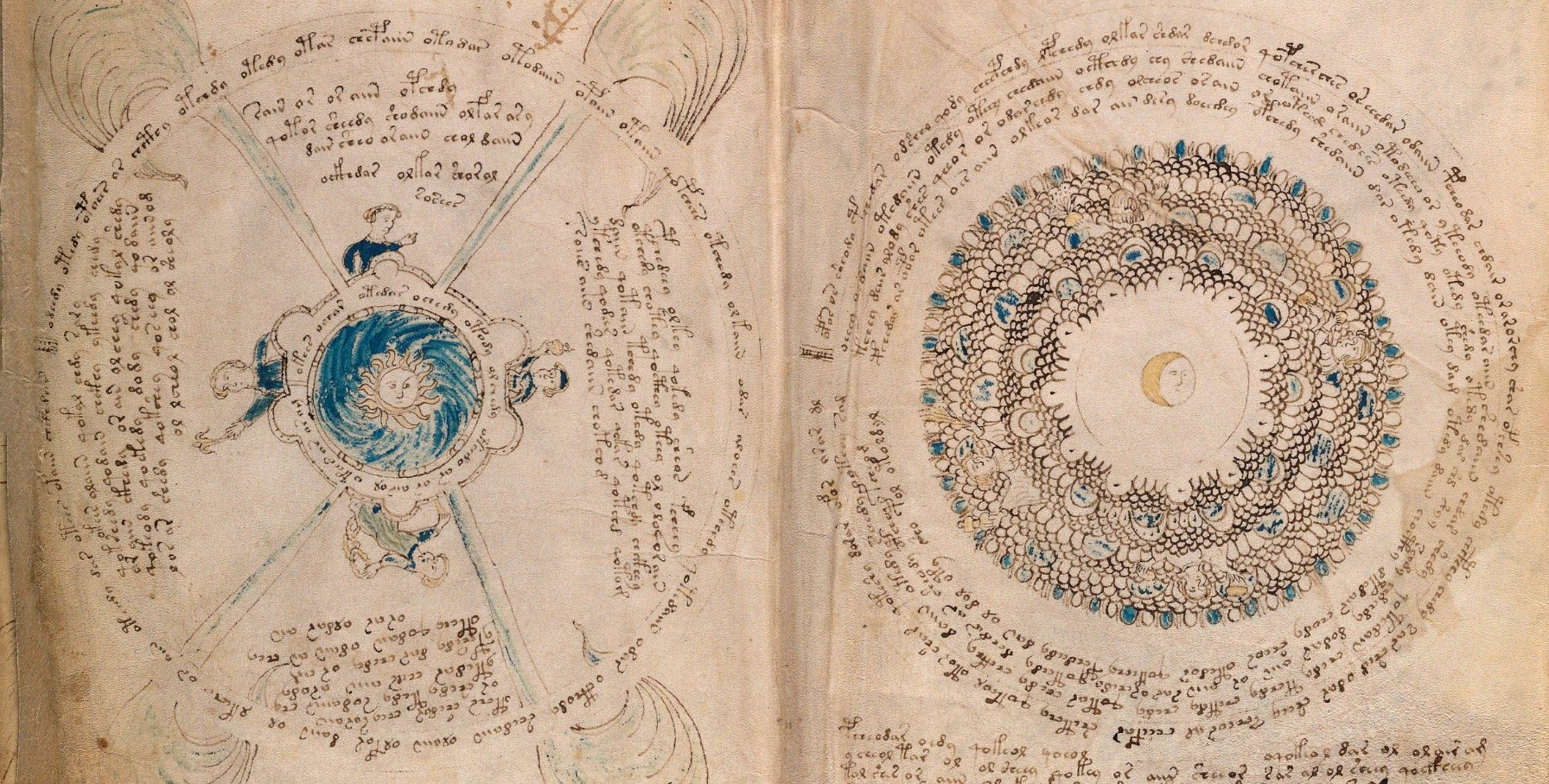
The sun and moon drawn in the center indicate that the left side represents daytime and the right side nighttime.
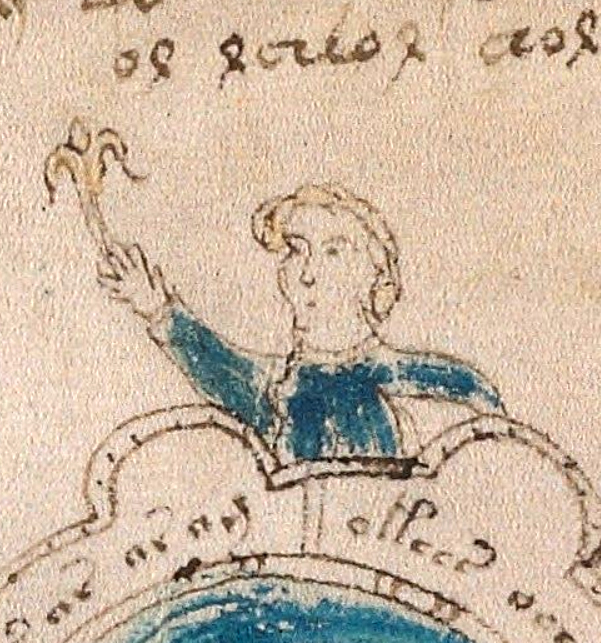
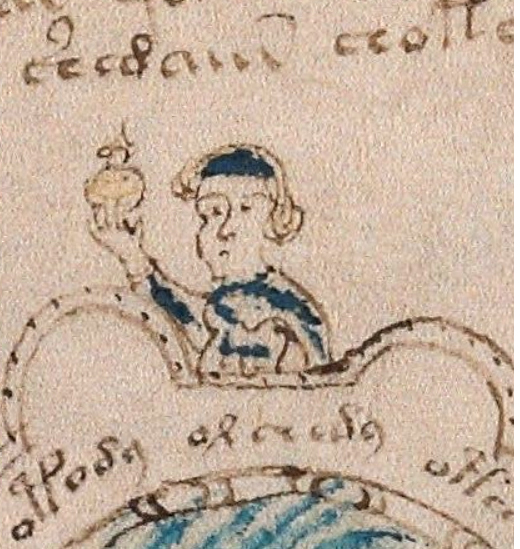 In the daytime scene on the left, there are four women. The woman at the top is pointing with her left hand toward something; the woman on the right is holding what appears to be a type of attachment; the woman on the left is holding something that looks like a type of plant; and the woman at the bottom has her right hand resting on a rod protruding from the ground, while in her left hand, she holds an object—possibly a component—that features an attached ring.
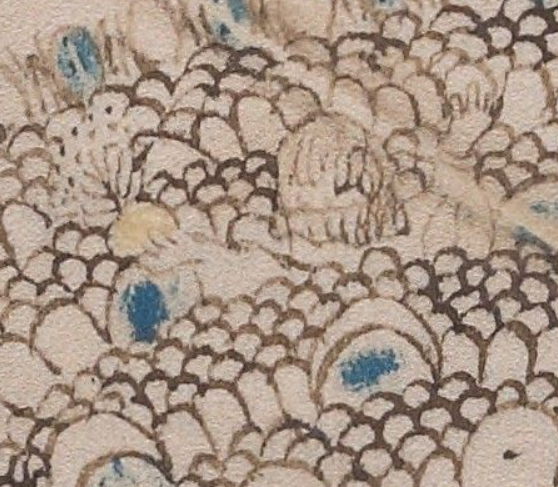
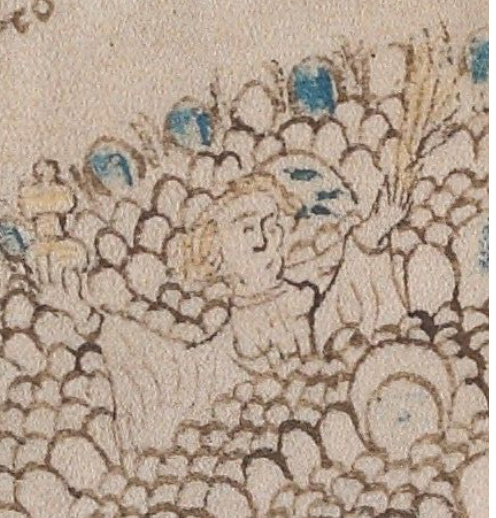 The nighttime scene on the right also shows four women. Two of them appear to be holding plants with flowers in bloom.
What can we read from this diagram?
*During the daylight hours, plants with good roots and plants with good stems and leaves are grafted together. After allowing some time to pass, the results are checked again. The chances of finding that beautiful flowers have bloomed may be about fifty percent.*
This is how the diagram can be read.In other words, could one say that this diagram illustrates a Hanasaki System "Flowering System"—a process through which flowers can be made to bloom?
Also, from the perspective of music composition, this brings to mind the familiar advice:
*When you've assembled a motif, leave it overnight and listen to it again before deciding whether it works.*
I believe the reason this manuscript describes the process of motif-making in such detail is that it seeks to convey a fundamental principle of composition: the initial motif is of great importance.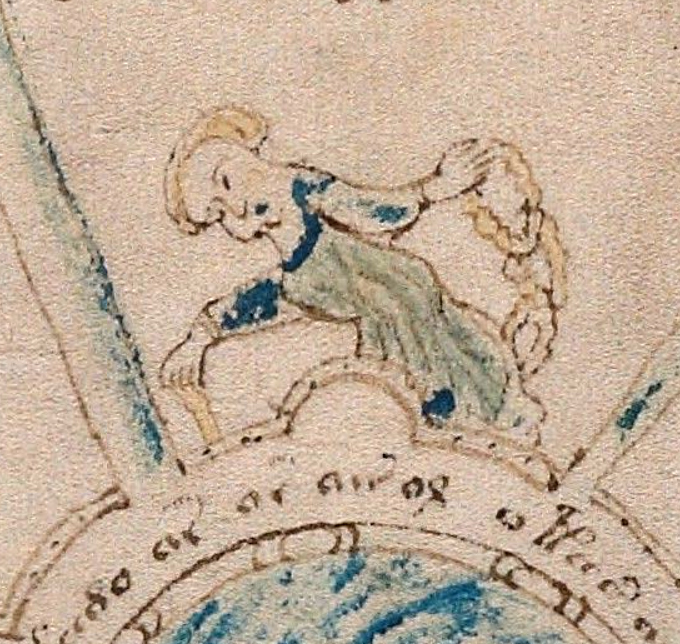
Also, among the four women in the daytime scene, the woman at the bottom touches a rod-like object extending upward from below with one hand, while holding a component made up of several large interconnected rings in the other.
I will return to this mystery later.